Southern Polytechnic State University

Fall 2004 Kickoff – Part I – The Retrospective

Tuesday, 17 August 2004

President Lisa A. Rossbacher


Welcome back to the start of the new academic year.  I appreciate you all being here for part one of a different way of approaching the traditional “fall kickoff” at Southern Polytechnic.


Fall kickoff this year will be in multiple parts.


Today, we will start with a retrospective that looks at the accomplishments we have made in the last few years.  We’ll look at where we’ve been and how we got to where we are now.  We’ll look at how our history ties to our special mission.


This retrospective is important for several reasons.  It’s a reminder of our progress and an introduction of our history to new members of our community.  The focus today will also set the stage for tomorrow’s discussion about our future.  During the session, I’ll ask for your feedback, which I’ll incorporate into my remarks tomorrow.


Tomorrow (18 August), I will give the traditional “State of the University” presentation, in which we’ll look forward, emphasizing where this University is now and where we are going – that’s the “vision” part.  We’ll look at what’s next and who is going to make it happen.  Our ultimate outcome will be a revised strategic plan for the university.


The retrospective


SPSU has been building on its successes ever since it opened its doors in 1948.  We aren’t reinventing;  we are building…and continuing to build.  We’re focusing and getting increasingly focused on our goals, our mission, and our vision.


Let’s look at where we have been, specifically over the past six years.  This is a review for some of you, but it is new to others.  It’s interesting to note how many of the faculty and staff on this campus are new to the University community within the last five years.  Among full-time employees, 41% have started working here within the last five years – since September 1999.  Among staff alone, almost 48% are new in that period of time…and 27% of the full-time faculty have been here less than five years. 


Toward the end of my presentation, I’m going to ask for each of you to write down the three most important accomplishments of the last six years in moving this university forward, and I’ll be especially interested in anything that I may have left off my list, as well as reinforcement for what is on my list.  So I hope you’ll be paying attention and checking my work.


In a way, this review of past accomplishments is a way of “connecting the dots” – showing how where we’ve been has led us to where we are.


Let’s look together at where we’ve been since the fall of 1998.  Of course, this isn’t where time begins.  Our accomplishments build on the great foundation that was established before I got here…but the events in the past six years are also the ones I know about first hand.  And given that nearly half the people who currently work here have not experienced this directly, it’s worth reviewing.


In 1998-99


  • We completed the new facilities master plan.
  • SPSU joined Yamacraw, Governor Barnes’ high-tech initiative for economic development.
  • We started the Telecommunications program with ICAPP funds.
  • The president chaired the Board of Regents’ Hispanic Task Force for the University System of Georgia.
  • SPSU piloted a new approach to privatized student housing on campus.


In 1999-2000


  • SPSU’s student chapter of the National Society of Black Engineers won three regional awards.
  • Academic Affairs began a formal process of program review.
  • We completed the first draft of a new academic plan.
  • The Software Engineering Retraining Program (ICAPP) was developed in collaboration with Lockheed Martin Aero.
  • The Steel Bridge Team, Aerial Robotics Team, and Supermileage Vehicle won national awards.
  • The Spanish minor was approved by the Board of Regents.


In 2000-2001


  • The campus identified increasing visibility, enrollment, and resources as the highest priorities.
  • New undergraduate and graduate degrees in Information Technology were approved.
  • The new B.S. in Software Engineering was approved.
  • Grants awarded from the National Science Foundation included $270,000 for scholarships and $135,000 for faculty research into science as a profession in the U.S.
  • George Will gave a public lecture on campus.
  • The Goizueta Foundation funded $223,620 for a new language lab.


In 2001-02


  • The University created schools of Architecture, Civil Engineering Technology, and Construction; Engineering Technology and Management;  Computing and Software Engineering; and Arts and Sciences to encourage collaboration and cooperation.
  • A new B.S. degree in biology was initiated.
  • Advising, tutoring, and testing services were linked with international student services, to strengthen academic support for students.
  • The University’s strategic plan was updated.
  • We began marketing SPSU as "Georgia's Technology University."
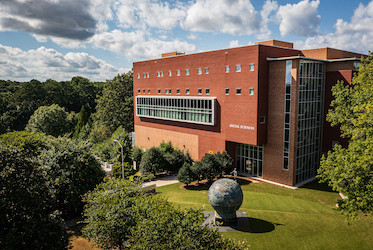
  • The new Architecture building was completed and occupied.
  • Career Services merged with Counseling to provide better service to students and prepare them for post-graduation employment.
  • The Goizueta Foundation funded $526,380 for Hispanic scholarships.


In 2002-03


  • We identified our “hedgehog”:  The intersection of what we're passionate about  (developing mature minds), what drives our economic engine (superior students), and what we can be best in the world at (applying technology).
  • We defined the "five big rocks" (those items that are so important that we need to address them first, before finding room to consider other, less critical issues):  strengthening academic programs, increasing enrollment, establishing a campus-wide ethic of customer service, creating a strong "sense of place," and increasing private resources.
  • The Board of Regents approved state funding for a minor capital outlay project for infrastructure (including Building E) and a student competition lab building.
  • We began systematically publicizing the “elevator statement.”
  • The Center for Teaching Excellence started operations.
  • The new degree program in International Studies:  Global Technology started.
  • We began offering the M.S. in Systems Engineering.
  • Women's basketball came to SPSU.
  • Bill Bennett presented a public lecture on campus.
  • The POWER (Polytechnic Outreach for Women’s Education and Retention) program for women students started.


In 2003-04


  • New signs on I-75 included the full name of the University.
  • The facilities master plan was used to argue for purchase of the adjacent Life University campus (not implemented) and the addition of a new mathematics and engineering building to the Board of Regents capital outlay list (successful).
  • The new and innovative University Honors Program began.
  • The University community focused on "creating and investing resources" as a way to make strategic budgetary decisions.
  • The Board of Regents approved $30 million for a new Mathematics and Engineering Building at SPSU for the USG Major Capital Outlay Priority List.
  • Grant activity included a total of $334,518 from NASA to Dr. Chih-Cheng Hung since 2002 and more than $405,000 from the National Science Foundation to Dr. Patrick Bobbie since 2003.


In previous years, at this time of year (fall kickoff), we’ve talked about focusing our energies on increasing our visibility, our enrollment, and our resources.  We’ve talked abut the “five big rocks” as a way to be sure we were emphasizing the important issues, before we got distracted by the smaller ones.  I’ve used the “hedgehog” concept from James Collins’ book Good to Great as a way to talk about the intersection of what we are passionate about, what we can be the best in the world at, and what drives our economic engine.  Last year, I spoke about creating and investing resources – and about metamorphic change, the adjustments that come with heat and pressure and the ways in which this University has responded to external stresses.


This year, I want to talk about solar systems and galaxies – tomorrow.


I now have three requests dealing with each of the three colored cards you have.


  • On the blue card, I’d like to ask you to list the most important achievement or event of the last few years (up to five years) that has moved this University forward and helped us fulfill our mission.  You may identify something I mentioned -- or something I didn’t.  I’ve love to know what I’m missing.


  • On the yellow card, please write down what do you think the primary vision for SPSU should be?  What should we look like in 3-5 years? 


  • On the pink card, please list the one change at SPSU that you believe would have the most positive effect on this University and our ability to realize our vision for the future.


This feedback will provide valuable information on both the University’s past and future, as well as some concepts for how to move toward that future from where we are right now.


I will compile your responses and incorporate them into tomorrow’s “State of the University” presentation, talking about where we are, where we are going, and how to get there.


Over the next week, we’ll have divisional meetings that explore the question of “What can my division, department, and I do to support the vision of the University’s future?”


Then, during the week of August 30, we’ll have a series of ten “fireside chats” in which we come together and look forward across divisions, departments, and disciplines to consider next steps and what each of us can do individually to support the University’s goals.


Following the “fireside chats,” I will outline the next steps in our campus-wide strategic planning process, revising the University’s plan to move forward and identifying what the University needs to do to get there.


Thanks for your feedback and for being here today…and I look forward to seeing you tomorrow.


*****